AI Implementation · Field Notes
How to Audit Your AI Marketing Systems Before They Fail
I developed a 4-step audit process that catches AI marketing problems before they cost you customers. Here's the checklist I use for every client.
Why AI marketing systems fail differently
Last month I prevented what could have been a six-figure mess. An audit caught a system three days from sending Valentine messaging to a divorce attorney client list in March. Metrics looked fine. Seasonal triggers and stale training data did not.
AI marketing rarely crashes with a red error page. It degrades: slight relevance drops, quiet targeting drift, content that slowly stops sounding like you. By the time conversion tanks, the frog is already boiled.
The SAFE audit framework
System performance and data quality. Accuracy and content relevance. Failure points and edge cases. Evolution and model drift. Directionally, a failure can cost tens of thousands; a thorough monthly audit is a fraction of that.
S: System performance and data quality
Most cascades start here. Weekly (about 30 minutes): completeness of key fields, freshness of sources, duplicate amplification. Daily (about 15 minutes): API latency, error rates, rate limits. Sustained API responses over ~500ms or error rates over ~1% deserve investigation before personalization silently falls back to generic.
A: Accuracy and content relevance
Sample recent AI outputs weekly. Score brand voice, verify facts, check segment match on dynamic blocks. Biweekly, watch engagement drift by content type and segment. Engagement usually falls before conversion does when content quality decays.
F: Failure points and edge cases
Script the ugly scenarios: empty CRM fields, out-of-season triggers, suppressed segments accidentally included, tool outages. Validate circuit breakers: what happens when the model or API dies? Does it fail closed (safe default) or send nonsense?
E: Evolution and model drift
Track performance trends against baselines. Define retraining or prompt-refresh triggers: sustained CTR drop, rising hallucination rate, segment mix shift, vendor model version changes. Drift is normal. Unmonitored drift is negligence.
Monthly cadence (~6 hours)
If something is already on fire, pair this with the 7-step diagnostic process. For the money story of failures, see hidden costs of AI marketing failures.
AI marketing system audits
- How often should we audit?
- Monthly deep audit plus lightweight daily/weekly health checks. Increase cadence after major model or vendor changes.
- Who owns SAFE?
- Marketing ops with engineering on APIs and a content lead on accuracy. One named owner beats a committee.
- What if we are too small for six hours?
- Compress to a 90-minute monthly pass focused on kill switches, sample content accuracy, and the top three integrations.
- How do we know an audit worked?
- Issues found before customer complaints, declining incident severity, and stable or improving conversion after changes.
- Is this the same as compliance review?
- No. SAFE is operational reliability. Pair with a compliance playbook for consent, claims, and policy risk.
Keep Reading
Related Articles
Pick the next guide based on where you are in implementation.
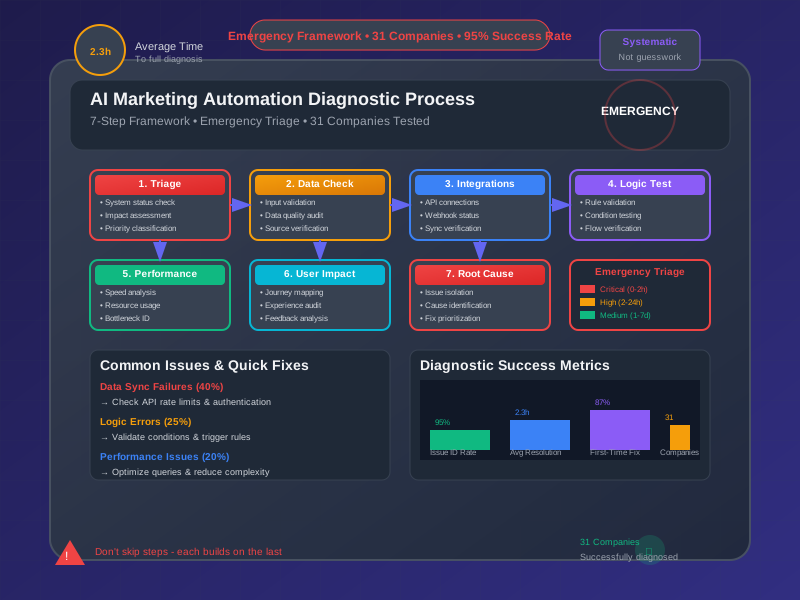
AI Marketing Automation Not Working? My 7-Step Diagnostic Process
A practical troubleshooting process for fixing underperforming AI systems.
Read article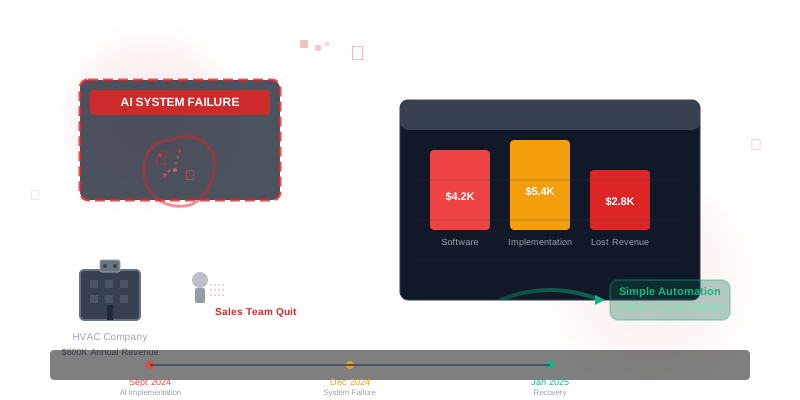
The Hidden Costs of AI Marketing Failures
Understand how technical issues turn into financial damage.
Read article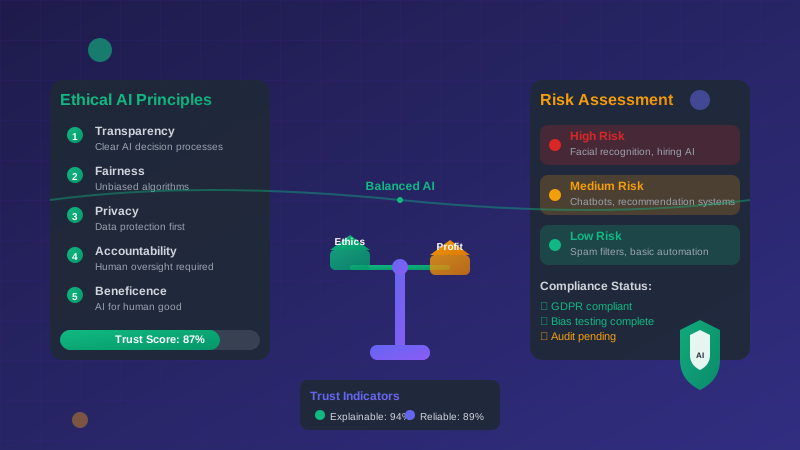
Compliance-First AI Marketing Playbook for 2026
Add governance and compliance controls to reduce operational risk.
Read articleNext step
Ready for systems that keep compounding?
Say hi, send a work brief, or dig through the Lab first. Same person on the other side. I reply personally.